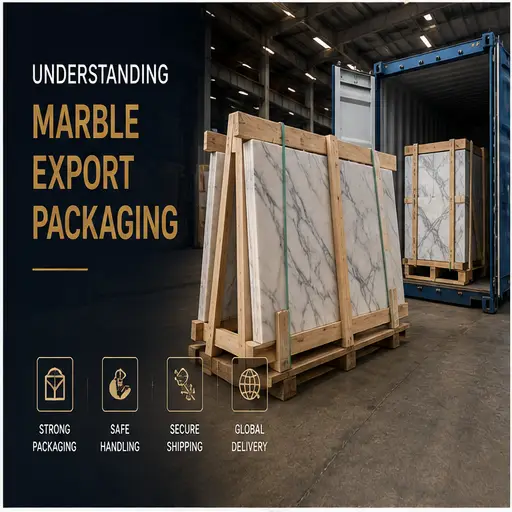
Marble is a heavy and relatively fragile natural material. Even high-quality marble can be damaged if it is not packed, supported, and loaded correctly.
For international shipments, proper packaging is therefore an important part of the export process.
Why Marble Packaging Matters
During international transportation, stone can experience:
Vibration
Impact
Handling during loading and unloading
Pressure from other materials
Moisture exposure
Movement inside containers
Proper packaging helps minimize these risks.
1. Surface Protection
Finished marble surfaces should be protected against scratches, dust, and impact.
Depending on the product, exporters may use:
Protective film
Foam sheets
Corrugated materials
Plastic protection
Edge protection
The objective is to prevent surface damage during handling.
2. Wooden Crates
Wooden crates are commonly used for marble tiles and smaller stone products.
A properly designed crate helps:
Keep products organized
Protect edges
Reduce movement
Make handling easier
Provide structural support
Crate construction should be suitable for the weight of the stone.
3. A-Frame Packaging for Slabs
Large marble slabs require specialized support.
A-frame systems can be used to hold slabs securely in position during transportation.
Slabs are carefully arranged with appropriate protective materials between surfaces.
4. Edge Protection
Edges are particularly vulnerable during handling.
Protective materials can be placed around corners and edges to reduce the risk of chipping.
5. Container Loading
Container loading is one of the most important stages of the export process.
The loading team should consider:
Weight distribution
Container capacity
Slab dimensions
Crate positioning
Internal supports
Securing materials
Safe unloading
The stone should be secured so that excessive movement does not occur during transportation.
6. Documentation and Packing List
The packing list should accurately describe the shipment.
Depending on the product, information may include:
Number of crates
Number of slabs
Tile quantity
Dimensions
Thickness
Net weight
Gross weight
Package identification
Accurate documentation helps with logistics and customs procedures.
7. Quality Check Before Loading
Before the container is sealed, an exporter should ideally verify:
Material quantity
Dimensions
Finish
Packaging
Visible condition
Container condition
Loading arrangement
Photographs and videos of the loading process can also be shared with the buyer for transparency.
Conclusion
Professional packaging is not simply about putting marble into a container.
It is a complete process involving surface protection, structural support, safe loading, weight distribution, securing, and documentation.
For international buyers, selecting an exporter with a reliable packaging and loading process can significantly reduce transportation risks.